
In forex trading, hesitation can really cost you thousands, and being dependent on gut feelings often leads to missed opportunities. Algorithmic forex trading completely flips the script, letting smart algorithms scan the market precisely, execute your trades instantly, and stick to a certain strategy without even emotion.
It’s not just automation. Over and above that, its precision, speed, along with discipline rolled into one.
In this blog, we’ll cover how algorithmic strategies actually work in real forex markets, the best platforms and tools for both beginners and pros, risk management techniques that actually protect your capital, and some actionable tips in order to optimize your trading. Moreover, you’ll learn how to trade smarter, faster, and even more consistently.
What is Algorithmic Forex Trading?

Algorithms for forex trading involve computer programs that automatically trade in the Forex market according to some predetermined rules. This strategy eliminates the human factor and automatically orders can be placed once many criteria, such as price ranges or technical indicators, are satisfied, unlike human trading.
General algorithmic trading is applied to commodities or stocks. On the one hand, algorithmic forex trading is designed specifically to deal with currency pairs, and it is designed to deal with their specific volatility and liquidity. To enhance consistency and efficiency, traders tend to use automated forex trading systems or Forex trading bots to scan multiple pairs, backtest strategies, and trade 24/7 to combine speed, accuracy, and discipline.
Why Algorithm Forex Trading Elevates Your Performance
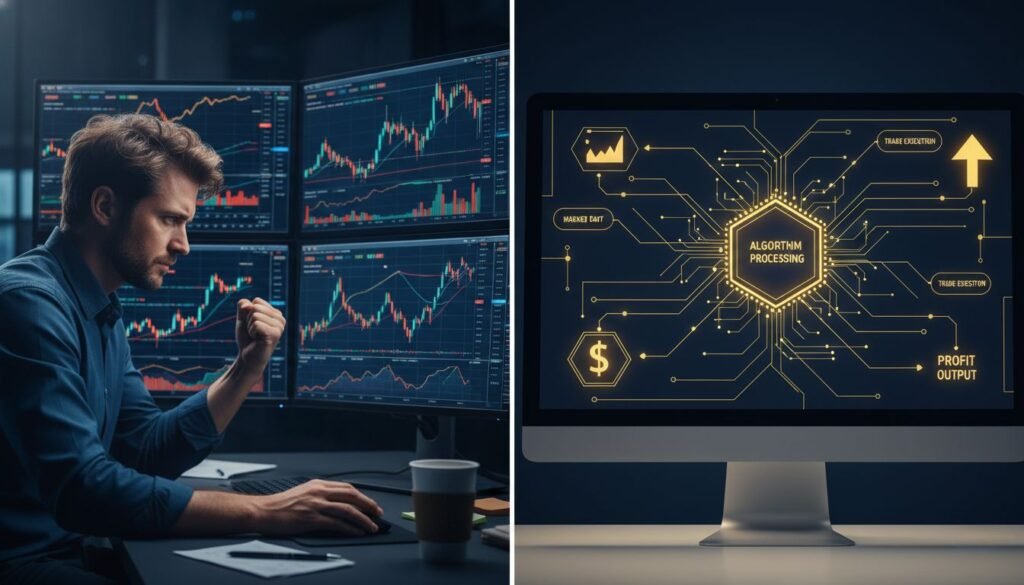
Forex moves really fast, and opportunities can vanish in seconds. Algorithmic forex trading provides traders with the speed and precision in order to act immediately, executing trades exactly when their strategy dictates. It eliminates emotional decision-making and allows your plan to run consistently even in volatile markets.
Here’s why it’s a performance booster:
Speed and Precision:
Algorithms have the potential to monitor currency pairs simultaneously and execute trades in milliseconds, far faster than any human.
Emotion-Free Trading:
Fear of greed, along with hesitation, always destroys results. But, automated strategies just stick strictly to rules, and keep your trades disciplined.
Backtesting for Consistency:
Before trading in the live market, you can test your strategies on historical data just to observe how exactly they perform under different market conditions.
Practical Profit Examples:
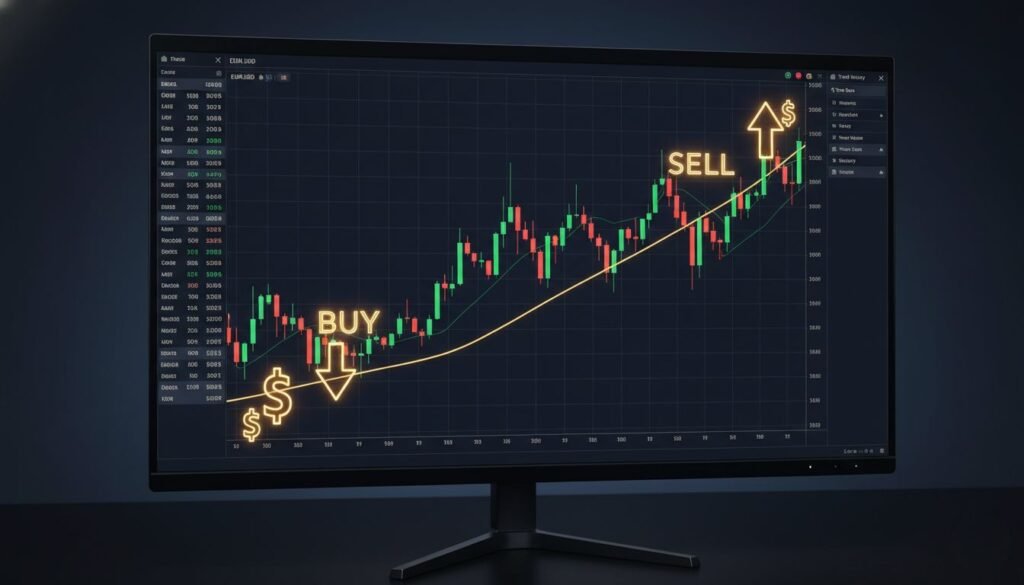
For example, a moving-average algorithm might buy EUR/USD when it gets dropped below the 20-day average and sell in when it gets raised. Applied consistently, small repeatable gains can really add up to cover time, something manual trading struggles to achieve across multiple pairs.
Popular Algorithmic Forex Trading Strategies
There is no strategy that fits every market as far as Forex is concerned. Experienced traders use a combination of proven algorithmic strategies to opportunistically capture opportunities. These are the most widely used methods and their real-world trading:
Moving Averages and Mean Reversion:
In this approach, prices are assumed to be moving around an average. An algorithm can automatically buy a currency pair when its price falls below a specified moving average and sell when it falls above it. There are small, repeat gains in the long run. The price tends to move around the moving average line, and visual charts help to identify the trends and reversals more easily.
Trend-Following Algorithms:
The trend-following algorithms identify powerful directional variations and implement the trade on the direction of that variance. An example is when EUR/USD is on a long-lasting upward trend, the algorithm will keep buying on pullbacks. This strategy is effective in trending markets but needs risk control in order to prevent losses in case of unexpected reversals.
The high-frequency arbitrage in the Forex:
High-frequency algorithms can also trade dozens or hundreds of pairs in a second by simply taking advantage of the price difference between brokers or currency pairs. Although it is highly profitable when properly implemented, it will need high technology and very low latency connections which trade professionals are concerned with.
Scalping Algorithms on Short-term profits:
Scalping algorithms look to achieve small, repetitive returns, typically of a few seconds or a few minutes. They are suitable for high liquidity pairs such as EUR/USD or GBP/USD. It is all about speed, low spreads, and strict exit guidelines to prevent the transformation of small profits into losses.
How to Start with Algorithmic Forex Trading?
Starting with algorithmic Forex trading could seem difficult, but when you break it down into simple steps, even beginners can handle it. Here’s a simple way to do it:
Step 1: Select the Appropriate Platform.
Pick a platform that is user-friendly and allows you to trade automatically. Some of the most used ones are MetaTrader 4 (MT4), MetaTrader 5 (MT5), cTrader, and Zorro. It does not require much of a code to access these platforms and run algorithms, backtest strategies, and monitor trades.
Step 2: Choose between Code Off-the-Shelf and Custom Programming.
- Ready-Made Bots or Expert Advisors (EAs): Trading with ready-built algorithms is possible immediately with tested strategies, and you can choose between ready-made bots or Expert Advisors (EAs).
- Custom Coding: MQL4, MQL5, or Python. Customize an algorithm to have greater control. This allows you to fully customize your style of trading.
Step 3: Decide how you intend to trade.
Decide whether you are interested in scalping, trends, or back to the mean. Your algorithm would know when to begin and close trades, which is why you should set clear goals.
Step 4: Test your algorithm using previous data.
Test historical Forex data to understand how your algorithm will perform under different market conditions. Only make changes when necessary and do not over-optimise, which makes it fail in real markets.
Step 5: Open a Demo Account
Test your algorithm on a demo account. This allows you to observe the real-time proceedings without risking your money, and it enables you to identify the potential errors or alterations.
Step 6: Take a gradual step to trade in reality
You need to be certain that your demo results will be the same, and only then begin trading with real money. Monitor performance and also optimize your algorithm accordingly.
Advanced Tips to Optimize Your Algorithmic Forex Trading
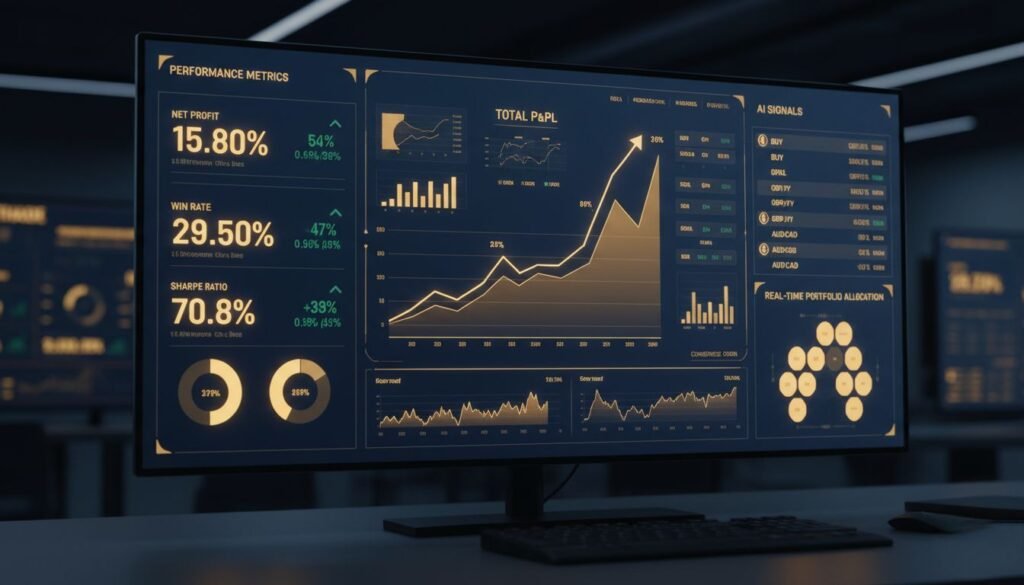
- Use moving averages, RSI, and MACD together to confirm trends and cut down on false signals.
- Use AI and machine learning to modify algorithms to fit with the way the market is changing.
- Keep an eye on your strategies in real time to identify unusual actions and market misalignment.
- Check your analytics often, such as win/loss ratios, drawdowns, along with profit factors.
- Slowly improve trade settings and don’t make them excessively specific to past data.
Conclusion
Algorithms in forex trading provide the trader with the ability to execute strategies faster, accurately, and in a disciplined manner that manual trading is unable to achieve.
Learning the strategies that will help you to be much more consistent and potentially profitable, choosing beneficial platforms, backtesting properly, and using additional optimization methods will help you to achieve that.
Remember that smart automation, active monitoring, and risk management are also the keys to success. The strategy transforms algorithmic trading into a mechanism and a strategy to achieve long-term success in Forex. You should begin small, experiment, and continue to get better.
